UDH_HC Mentorship & Enrichment Program

ORIGINES

L’UDH Health Coach est une organisation à but non lucratif engagée à contribuer dans l’avenir d’Haïti dans le domaine de la santé en investissant dans l’éducation et le développement des futurs leaders de ce secteur, en hommage à la mémoire de la regrettée Lyna Jean-Baptiste, enseignante.  Convaincus que les étudiants en sciences de la santé sont les piliers du système de santé de demain, nous œuvrons à renforcer les compétences locales en offrant un soutien éducatif de qualité et en favorisant des initiatives de développement communautaire dans le domaine sanitaire.

PROGRAMME:

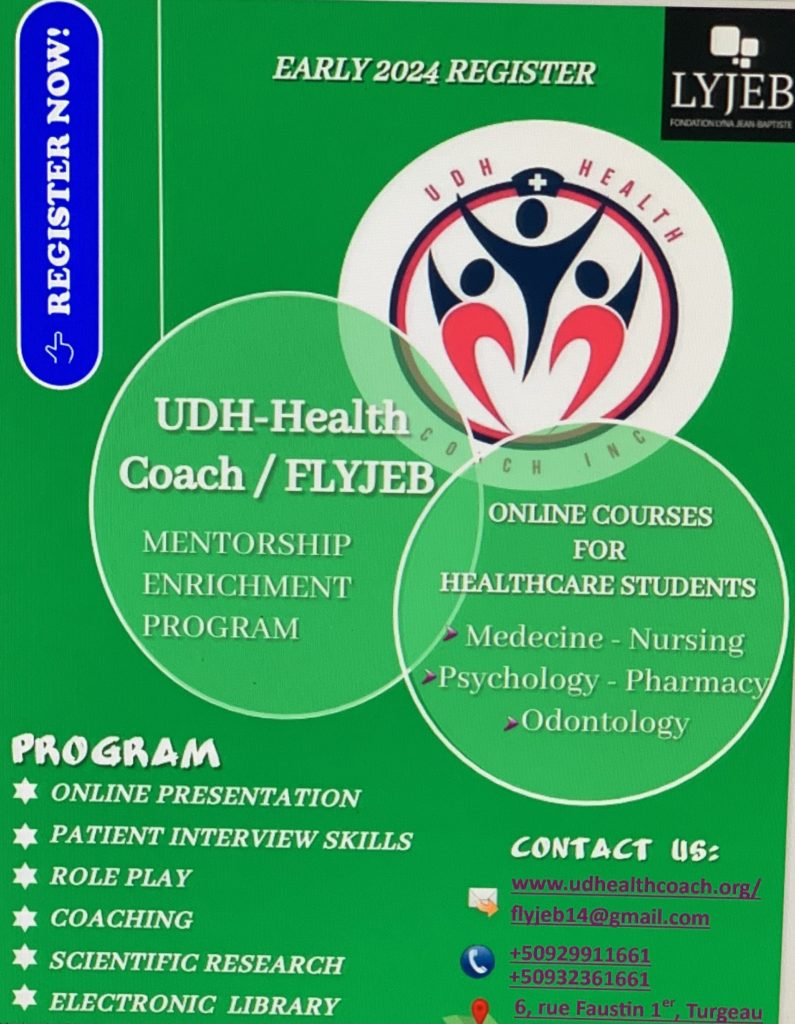
L’UDH Health Coach (UDH_HC) aux USA avec la coopération de la Fondation Lyna Jean Baptiste (FLYJEB) en Haïti,  propose un programme de mentorat destiné aux étudiants haïtiens en sciences de la santé (Médecine, Sciences infirmières, psychologie, Odontologie, pharmacologie). Ce programme offre une formation de qualité conforme aux normes internationales à travers des présentations bilingues en ligne. Grâce à une approche multidisciplinaire, inspirée des modèles de l’hôpital Cambridge Health Alliance et de l’Université Harvard, les participants bénéficient d’un accompagnement technique et professionnel adapté à leurs besoins.

Conditions de participation: Pour intégrer le programme, l’étudiant (e) doit 1-Être officiellement inscrit à la Fondation Lyna Jean Baptiste en tant que membre actif. 2-S’engager à suivre régulièrement les cours en ligne et les sessions de mentorat proposés. 3-Respecter les règles et conditions définies par l’UDH_HC pour le bon déroulement du programme. 4-Accepter de payer les frais d’adhésion ou de participation, si requis,  conformément aux directives de la Fondation.

LES MEMBRES: Étudiants haïtiens (2e, 3e, 4e. 5e, 6e, 7e année) inscrits dans une filière des sciences de la santé, tels que médecine, sciences infirmières, psychologie, odontologie, pharmacologie ou poursuivant des études avancées, résidant ou étudiant à l’étranger. -Bénéficient d’un accès prioritaire aux présentations en ligne, au site de l’organisation, au mentorat individuel et aux sessions de développement professionnel, au club d’anglais.                                  -Ont accès à la bibliothèque électronique -Participent aux activités aux projets en cours de l’UDH_HC et de la FLYJEB. -Bénéficient de ressources adaptées aux standards internationaux, à des opportunités de recherche collaborative. -Reçoivent un soutien ciblé pour développer des compétences pratiques, participent aux émissions radios UDHKwenSante et accéder à des stages d’observations.

LES LEADERS: Membres ayant obtenu la note requise par l’UDH_HC/FLYJEB à la fin de la session, et ayant démontré des qualités de leadership et manifesté un engagement envers les objectifs de l’UDH_HC et de la FLYJEB pourront être sélectionnés comme leaders. -Ces membres sont encouragés à jouer un rôle actif dans le programme, notamment en servant de mentors pour leurs pairs. -Bénéficient d’un accès complet au projet en cours d’UDH_HC.

Immigrant’s Guide to the U.S. Healthcare System

Immigrants new to the U.S. face a ton of issues. Some of us are lucky enough to receive help with those issues. For my part, I’m hoping to help you with the medical side specifically. Today I want to talk about the American healthcare system, which includes nurses, psychologists, etc. The main difference between Haiti and the U.S. is the U.S. healthcare system and how it’s organized based on need. It can initially be confusing, so I want to guide you through that. 

The healthcare system in the U.S. is split up in categories, the first category being the emergency rooms. Some people think that going to the emergency room will get them access to care quicker but that is not the case. Emergency rooms are specifically for people who have life-threatening injuries or are dealing with severe trauma. These people need to be taken care of immediately or they may die.

Now second, we have Urgent Care rooms, which are places designed for people who have health care issues that are urgent but cannot access their primary care physicians for whatever reason. It’s important to keep in mind that the physicians or providers in an Urgent Care Room are not necessarily equipped to address all sorts of illnesses

Now, the third, we have what we call a Healthcare Centre, a place where several specialists and providers are present to provide healthcare to patients. This group includes doctors such as internal medicine doctors, nurse practitioners, specialists, and physician assistants. You’ll also find dentists in a center such as Cambridge Health Alliance, as oral health is very important. 

When you first call, the front desk receptionist will answer your call and schedule an appointment, but if your healthcare issue is too complicated, they’ll transfer you to the nurse who will then decide whether or not you need to be sent to the emergency room. Otherwise if your issue needs immediate care but doesn’t require a trip to the emergency room, they’ll see who is available and schedule you an appointment as soon as possible. You also have the option to call your primary care provider’s clinic even after hours in case of an urgent healthcare issue.

I want to remind everybody the importance of being on time for their medical appointments because, once again, the healthcare system in the United States is very different from Haiti. In Haiti, if you are late for your appointment, the doctor will still see you. But in the United States, you will have to reschedule your appointment if you are more than 15 minutes late.

When you arrive at the healthcare center you will first be greeted by the front desk receptionist, after being checked in you will then be seen by the physician assistant who will ask you a number of questions. At that point they may also check your blood sugar and vitals depending on your issue. It may sound like a lot but this is how it works to be efficient. When you speak to your provider, they’ll ask you what the purpose of your visit is, among other things, to get a clearer picture of your health and the issue at hand. In Haiti we don’t have primary care providers so it’s understandably confusing to some Haitian patients who are used to a family medicine doctor doing something like a pap smear but be assured, these doctors are trained and will refer you to a specialist if your health issue requires them to do so. 

Often on the first visit, providers will do what is called an intake. This involves a lot of questions, often very personal, that the provider needs to ask to get a full picture of your health status. It may feel like the provider is being intrusive but this is for your benefit. Of course, everything said between you and your provider is confidential. All providers have to sign a HIPAA, a confidentiality agreement ensuring the provider may not share any of the patient’s information without their consent. Violating this agreement can lead to the provider being sued and facing legal issues. 

Furthermore, the intakes I mentioned before can be quite extensive. They’ll ask about your family history, what sort of illness runs in your family, whether you smoke, drink, etc. Depending on the intake, the questions may differ. Understand once again that this is not the providers trying to be intrusive. This is necessary information to provide the best care possible.

Depending on your issue, your healthcare provider may refer you to a specialist, and I may also insist on you coming back after that visit. This may be necessary for your primary care provider to discuss the specialist’s diagnosis with you in greater detail or to explain anything unclear to the patient.

During your visit your provider may also offer vaccines to you, which are especially important for people who are going to start a new job or school. A couple of examples are the hepatitis B vaccine, the Covid vaccine, the influenza vaccine, and the Tetanus vaccine. Another very important vaccine is the HPV vaccine, especially important for us because in Haiti this vaccine isn’t available and a lot of patients have cervical cancer.
During your visit, there is a physical exam, which may include a pelvic exam and pap smear to look for the HPV virus in female patients. A pap smear is a screening test and during your visit, you may need to do a couple of different screening tests depending on your age. These include a TB test, an HIV test, or a Hepatitis test. These are important to screen for because the earlier they’re screened for, the better the chances they can be cared for effectively.

Welcome to immigrants to the US medical/culture 

How to adapt to your new life as a migrant in the U.S.

Presented By Christian Massillon, psychologist and lawyer.

He spent three months at the Cambridge Health Alliance hospital doing an observership, where he learned a lot. Now, in Haiti, he’ll share his perspectives on adapting as a migrant.

“Adapting to a new culture can be a challenge for anyone, especially for migrants to the United States. New customs, a new language, and a new way of life can be bewildering and stressful. It can take time to adjust to the culture shock we face when we find ourselves on the doorstep of a new country,” He explains. 

In this article, the psychologist, accompanied by Dr. Jean-Baptiste, will discuss adaptation and what’s at stake and share some tips on adapting to your new life as a migrant in the USA.

Understanding culture shock and the obstacles that can affect the character of migrants

Culture shock is a psychological reaction when you are confronted with a new way of life upon relocation. It can manifest itself into feelings of confusion, distress, loneliness, and anxiety, and it happens when you’re being faced with adjusting to things being done differently from what you’re used to. These feelings can make a person more prone to violence. It’s important to understand that culture shock is a normal reaction. It takes time to adapt to a new culture, and it’s normal to feel complex emotions during this period.

Let’s take the case of a person from South America emigrating to North America, more specifically, the United States. This person is likely to encounter many obstacles along the way, which may affect their actions, thinking, and character. This can lead to frustration as things turn out differently than expected. There may be reactions such as avoidance, and this person may sometimes become violent, not knowing how to channel their emotions. A whole range of emotions can take place when faced with living in a brand-new environment. But with time and effort, you can overcome culture shock and create a new life.

Violence

This is an important subject to focus on. Violence is a serious problem in many communities. It can take many forms, including domestic violence, verbal abuse, sexual violence, and child abuse.

Dr. Jean-Baptiste mentions violence by men against women and also argues that violence is not acceptable in any form but that in some cultures, violence is accepted or even encouraged on some level. This is the case in some areas of Haiti, where it is considered normal for men to beat their wives or for adults to abuse children.

Causes of violence in the Haitian community

Dr Massillon shares his opinion on this subject.

Haitians are particularly vulnerable to this type of violence, because of their history of trauma and the culture of violence that exists in this country from colonial times to recent conflicts. Violence is somehow imprinted on us. Whenever we are unable to control our emotions, we become violent as parents who beat their children, or husbands who beat their wives. This history of trauma has left its mark on Haitian culture, and violence is often seen as a normal way of resolving conflicts. When we talk about violence, we’re not just talking about physical violence, but also verbal violence.

So we need to heal from all these forms of trauma and violence. Because it’s a form of trauma that we learn and that doesn’t do us any good, because violence only harms other people as well as ourselves. So it’s very important to recognize that we carry this kind of trauma with us and that we need to heal from it in order to progress. In order to grow, we need to unlearn this form of reaction.

Dr Jean Baptiste said it was good that Dr Massillon underlined the fact that we transmit this kind of trauma, the reaction to violence, from generation to generation. When a child misbehaves, often the parent’s reaction to this is in the form of physical punishment, like getting beaten with a  belt. Then, when this child goes to school and fights, the teachers will question him regarding his behavior, and the child may report what is happening in his family environment. In such situations, parents may lose custody of their children.

Sometimes, we are not in conflict with someone, but the way we react to someone may be perceived as a threat in some cultures, like in the U.S. Therefore, we must learn to recognize and deal with this type of reaction, which has become like a normal reaction for us, it’s like permissive violence.

Then there’s sexual violence or sexual abuse. The consequences for victims can be devastating in these cases. It is, therefore, necessary for parents and elders in the community to keep an eye on their children because there are a lot of predators out there. It’s something prevalent in our culture that we perhaps don’t talk about enough. We must watch our children, even when they go to the bathroom. It’s up to us to protect them. When children are victimized, it can lead to physical injury, psychological trauma, and mental health problems. Predators are severely punished when convicted. The abuser may spend years in prison, may never be granted residency, or may even be deported to their country of origin.

It’s also good for men and women to learn what’s appropriate when touching their children. It’s important to make people aware of potential problems and encourage them to report any suspicion of child sexual abuse.

If a child has marks on their body, it’s essential to ask what happened. It’s also important to believe the child and take their allegations seriously. If you suspect that a child is sexually abused, report it to the authorities.

It is also essential for clinicians to be alert to signs of child abuse. This may include physical injuries, changes in behavior, or statements made by the child. Children who are abused at home indeed tend to stay away from other children. This may be due to many factors, including shame, isolation, or fear. Abused children may also have difficulty concentrating or learning, which can affect their performance at school. That’s why teachers and other educational professionals need to be alert to the signs of child abuse.

In conclusion, Haitian migrants arriving in the U.S. need to be aware of the challenges they are likely to face, including culture shock, violence, and legal differences that can make the transition difficult. It’s important to prepare for these challenges and understand that culture shock is a normal reaction to moving to a new place. It can lead to feelings of confusion, distress, and isolation. It’s also important to remember that culture shock is temporary and usually fades with time.

Adapting to a new culture takes time. Refrain from understanding everything or feeling comfortable immediately. Learn the laws of the United States, especially those concerning domestic violence, sexual violence, and child abuse. Be open to the new culture. Be patient. Try to understand the cultural differences between Haiti and the United States. Be careful when interacting with others.

By following these tips and taking these precautions, you can protect yourself from trouble and increase your chances of successfully adapting to life in the United States.
UDH_HC KWEN SANTE!!! DID YOU KNOW!!!

Immigrant’s Guide to the U.S. Healthcare System

Immigrants new to the U.S. face a ton of issues. Some of us are lucky enough to
receive help with those issues. For my part, I’m hoping to help you with the medical side
specifically. Today, I want to talk about the American healthcare system, which includes
nurses, psychologists etc. The main difference between Haiti and the U.S. is the U.S.
healthcare system and how it’s organized based on need. It can be confusing at first, so I want
to guide you through that today.
The healthcare system in the U.S. is split up into categories, the first category being the
emergency rooms. Some people think that going to the emergency room will get them access
to care quicker, but that is not the case. Emergency rooms are specifically for people who
have life-threatening injuries or are dealing with severe trauma. These people need to be
cared for immediately, or they may die.
Second, we have Urgent Care rooms designed for people with urgent health care issues who
cannot access their primary care physicians for whatever reason. It’s important to remember
that the physicians or providers in an Urgent Care Room are not necessarily equipped to
address all sorts of illnesses.
Now, the third, we have what we call a Healthcare Centre, a place where several specialists
and providers are present to provide healthcare to patients. In this group, you’ll find doctors
such as internal medicine doctors, nurse practitioners, specialists, and physician assistants.
You’ll also find dentists in a center such as Cambridge Health Alliance, as oral health is very
important.
When you first call, the front desk receptionist will answer your call and schedule an
appointment for you, but if your healthcare issue is too complicated, they’ll transfer you to
the nurse, who will then decide whether or not you need to be sent to the emergency room.
Otherwise, if your issue needs immediate care but doesn’t require a trip to the emergency
room, they’ll see who is available and schedule you an appointment as soon as possible. You
also have the option to call your primary care provider’s clinic even after hours in case of an
urgent healthcare issue.
I want to remind everybody of the importance of being on time at your medical appointments
because, once again, the healthcare system in the United States is very different from Haiti. If
you are late for your appointment in Haiti, the doctor will still see you. But in the United
States, you must reschedule your appointment if you are more than 15 minutes late.
When you arrive at the healthcare center, you will first be greeted by the front desk
receptionist; after being checked in, you will be seen by the physician assistant, who will ask
you several questions. At that point, they may also check your blood sugar and vitals,
depending on your issue. It may sound like a lot, but this is how it works to be efficient.
When you speak to your provider, they’ll ask you what the purpose of your visit is, among
other things, to get a clearer picture of your health and the issue at hand. In Haiti, we don’t

have primary care providers so it’s understandably confusing to some Haitian patients who
are used to a family medicine doctor doing something like a pap smear, but be assured, these
doctors are trained and will refer you to a specialist if your health issue requires them to do
so.
Often on the first visit, providers will do what is called an intake. This involves a lot of
questions, often very personal, that the provider needs to ask to get a full picture of your
health status. It may feel like the provider is being intrusive, but this is for your benefit. Of
course, everything said between you and your provider is confidential. All providers have to
sign a HIPAA, which is a confidentiality agreement ensuring the provider may not share any
of the patient’s information without their consent. Violating this agreement can lead to the
provider being sued and facing legal issues.
And furthermore, the intakes I mentioned before can be quite extensive. They’ll ask about
your family history, what sort of illness runs in your family, whether you smoke, drink, etc.
Depending on the intake, the questions may differ. Understand once again, this is not the
providers trying to be intrusive. This is necessary information to provide the best care
possible.
Now, depending on your issue, your healthcare provider may refer you to a specialist,
and I may also insist you return after that visit with the specialist. It may be necessary for
your primary care provider to discuss the specialist’s diagnosis with you in greater detail or to
explain anything unclear to the patient.
During your visit, your provider may also offer vaccines to you, which are especially
important for people who are going to start a new job or a new school. A couple of examples
are the hepatitis B vaccine, the Covid vaccine, the influenza vaccine, and the Tetanus
vaccine. Another very important vaccine is the HPV vaccine, which is vital for us because in
Haiti, this vaccine isn’t available, and many patients have cervical cancer.
During your visit, a physical exam may include a pelvic exam and pap smear to look for the
HPV virus in female patients. A pap smear is a screening test, and during your visit, you may
need to do a couple of different screening tests depending on your age. These include a TB
test, an HIV test, or a Hepatitis test. These are important to screen for because the earlier
they’re screened for, the better the chances they can be cared for effectively.

Une page dans l’histoire de la vie de l’institutrice Lyna JEAN BAPTISTE.

   Par son neveu Colbert Bien aimé Fils.

Lyna Jean Baptiste travailla comme institutrice d’abord à l’école congréganistes des sœurs du Sacré cœur de Turgeau à Port-au-Prince, ensuite à l’école public Simone Ovide Duvalier, et à l’école des sœurs à Cabaret. Elle enseigna avec beaucoup de patience, cette grande patience lui avait permis d’éduquer et de former des milliers d’élèves tant à Port-au-Prince qu’à Cabaret. L’institutrice Lyna joua un rôle très important dans l’avancement de la communauté de Cabaret.

En Collaboration avec sa sœur Mme.Colebert Bien-aimé, elle créa une organisation qui s’appelait CREPROF (Centre de recherche pour la promotion féminine).Cette organisation permettait à plusieurs jeunes filles de Cabaret d’apprendre une profession comme la couture, la cuisine.

Ensuite Lyna et Mme.Colebert créèrent un moulin coopératif. C’était un moulin de Maïs et de Riz, qui aidait les paysans de Cabaret, à décortiquer  le riz, et à transformer le maïs en maïs moulu, le maïs qu’ils produisaient dans leurs jardins.

Lyna continuait à travailler comme institutrice à l’école des sœurs de Cabaret, jusqu’à sa retraite dans les années 1980. Après sa retraite elle immigra à Boston, où elle mourut le 14 Juillet 2013 à l’âge de 97 ans

Faculty of Nursing Sciences UNDH (P-AU-P)

Faculty of Nursing Sciences UNDH (P-AU-P)  

On behalf of the entire team of the Faculty of Nursing Sciences of the University Notre Dame Haiti, I thank the entire UDH Health Coach Team and can’t emphasize enough how important this was for our Nurse Teachers.

Thank you Mr. Alix Siméon for this training which the UNDH nurses have benefited from thanks to your determination. Today is a day of joy and appreciation for all the efforts made to complete this training.

Congratulations to all those who participated in this program and more specifically to the three UNDH nurses who passed all the modules. My dear colleagues today you are rightly savoring your hour of glory because you have prepared and worked for it. Congratulations!

As a Nurse Educator and Dean of a Faculty, I can tell you that at a certain point in your career, passing on your knowledge becomes second nature for some health professionals. One then becomes useful as a trainer to other health professionals. This is the case for nurses who teach. Indeed, transmitting one’s knowledge requires specific skills, mainly in terms of pedagogy. It is undeniable that the trainer must have a certain appetite for teaching in order to be successful. It’s also important that they have several years of experience in different fields to have a solid knowledge of the profession and its nuances. Hence the importance of this training organized by UDHHC. They offered participants the opportunity to reflect on their own practices in order to assert themselves in their role as a referent, whether in front of their colleagues or students. Clearer with the pedagogical foundations useful for supporting students, the practitioner trainer brings real added value to develop his entire team towards meaningful support practices. Knowing that currently in our various training institutions:

  • On the one hand, there is a severe lack of continuing education for executives working in the field of health.
  • On the other hand, the digital space represents a significant asset for training; however, its lack of human interaction is a weakness, making it less attractive for teachers and students.

So, I can say that this training makes it possible to underline two essential elements in the future of the profession and the training of nurses. One, being the necessary implication in the research of the profession and, the other being a reconsideration regarding the role of the trainer as orienting more towards a posture of accompaniment.

All our gratitude to UDHHC for having put a mixed team of recognized trainers to help in the training of nurses.

Thanks!

Esther JOSEPH MSN, RN Dean Faculty of Nursing Sciences / UNDH